Learn › Strategy games around the world › A traveler's guide
A traveler's guide to strategy games
Every article on this shelf ends the same way: the game crossed borders, found tables, made strangers into rivals. This last one hands you the luggage. Strategy games are travel's best social technology — the one reliable way to sit across from a local, share an hour of real contact, and need no language at all. Here's the field guide: where games live in public, how to be a graceful guest at them, what to pack, and why your phone's lobby is a form of travel too.
The universal handshake
Travel's oldest problem is that contact is hard: conversation needs language, hospitality needs invitation — but a board needs only a nod at the empty chair. The translation article explains the mechanics of the miracle: open-information games teach by demonstration and play without a shared word. This article is about the practice — because a game with a stranger delivers something tourism rarely does: an hour of genuine, structured, mutual attention. You're not observing a local; you're contending with one, and losing to one, which is the fastest respect-building exercise two strangers can run.
Players who travel this way collect the same report: the games are the trip they remember. The cathedral was beautiful. The old man who destroyed them at xiangqi in the park, twice, while a crowd laughed — that's the story they still tell.
Where games live in public
Every game culture keeps public habitats, and reading a city's game map is a learnable skill. Parks and plazas are the great habitat: chess tables in city parks across Europe and the Americas; xiangqi crowds in Chinese and Vietnamese parks — listen for the sharp click of pieces and the commentary of onlookers; Go in East Asian parks and dedicated salons. Cafés hold the Mediterranean and Middle Eastern backgammon belt — tables worn shiny, dice rattling from mid-morning — plus Europe's board game cafés and East Asia's baduk clubs. Shade is the mancala belt's address: oware under trees, bao benches on the Swahili coast, congkak on Southeast Asian porches. And everywhere: markets, waterfronts, university quads — anywhere chairs face each other and afternoons are long.
The finding technique is universal: walk slowly, listen for clicks and laughter, look for a standing crowd around something small. A ring of spectators watching two seated people in silence is a game, in any country, every time.
Etiquette abroad, in ten lines
Public game cultures run on unwritten rules, and the graceful-guest version fits in ten lines. Watch first — always; spectating is welcome nearly everywhere and teaches the local dialect. Ask before sitting: a gesture at the chair and a raised eyebrow is a complete sentence worldwide. Settle stakes before the first move — many public tables play for small money; a friendly shrug and empty palms ("no stakes?") sorts it wordlessly. Respect the queue: busy tables run winner-stays; know whose turn is next. Match the tempo: fast tables find slow play rude; slow tables find blitzing worse. Lose graciously and often — you're the visitor; the local sharks are the attraction. Praise with your hands: tapping the table or replaying their best move draws smiles in any language. Buy the tea where tea is bought — loser's privilege in half the world's cafés. Defer to elders: across most game cultures, the older player is the institution; treat them like one. And thank with a rematch offer: asking to play again is the sincerest compliment the table understands.
House rules everywhere
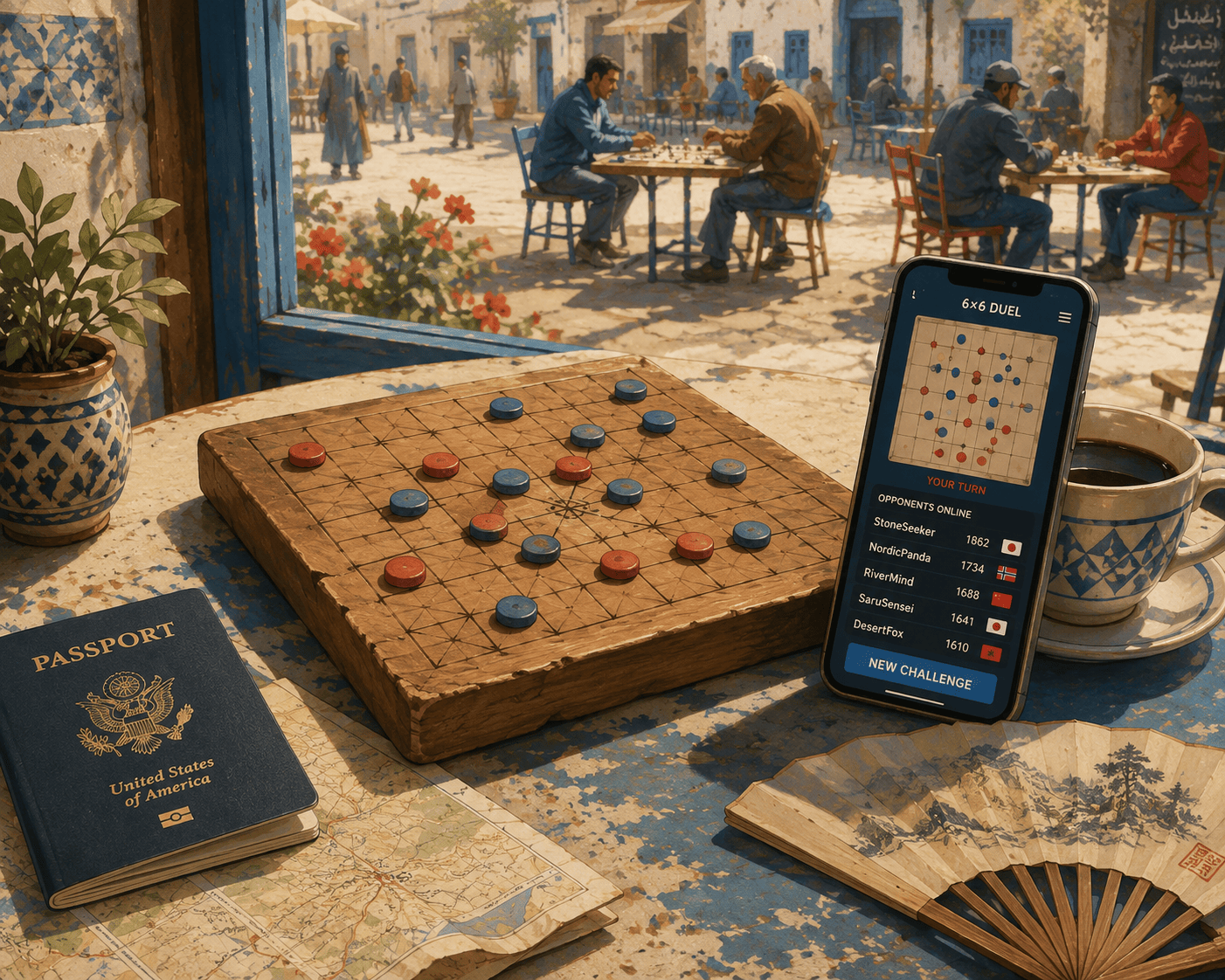
Here is the traveler's most important mental adjustment, and it's one sentence: the local rules are not wrong. Sit down to checkers, backgammon, mancala, or dominoes abroad and the rules will differ from yours — captures you don't expect, openings you've never seen, scoring nobody warned you about. The beginner's instinct is to correct; the connoisseur's is to collect. You're watching the folk process live: every region's variant is a legitimate branch of the family, tuned by its own generations, and encountering one is the game-cultural equivalent of tasting a regional dish that never gets exported.
So play by house rules, always, and take notes after. A collected rule difference is the best souvenir there is: weightless, free, and unavailable in any shop. Serious game travelers keep a variants notebook the way birders keep a life list — and the world's tables never stop adding species.
The pocket kit
What should a game traveler actually pack? The honest modern answer is short. A deck of cards remains the universal fallback — flat, welcome everywhere, infinitely fluent. A magnetic fold-board (chess one side, checkers-capable the other) earns its weight if you'll seek tables where boards may be scarce. Beyond that, improvisation is the tradition: every classic on this shelf plays with pebbles and a scratched grid, which is how they crossed the world in the first place.
And then the real kit: the phone is your whole game shelf in airplane mode. A charged phone carries chess, Go, the mancala belt, the chess dialects, and the modern duels — with AI opponents who need no connection at all. This is where a game like Oustwit earns its place in the luggage: built for exactly this life — offline AI for the flight, five-minute matches for the queue, a whole strategy gym in the dead hours travel manufactures. The traveler's rule of thumb: pack one physical icebreaker for meeting people, and let the phone carry the library.
The worldwide lobby as travel
Which points at the guide's quiet twist: the lobby in your pocket is a form of travel. Filter a matchmaking queue by country and you're doing tourism between flights — an opponent in a place you've never been, contending with you in the one language that needs no translation. Async games across time zones are the modern correspondence tradition: a move over their breakfast, a reply over yours, a months-long acquaintance conducted entirely in moves — pen-pals, minus the pens.
Treat lobby travel with the same etiquette as park travel and it pays the same way: rematch offers as compliments, graceful losses, curiosity about how differently they play. Regional styles are real — aggression here, patience there, opening fashions that cluster by community — and learning to read them is the connoisseur's version of reading accents. The old promise of this whole shelf — every border already crossed — cashes out here: the world's tables merged into one, and it's open all night.
An itinerary for game pilgrims
Finally, for the reader who plans trips around obsessions, the bucket list — the places where game culture runs thickest. Sit in a Japanese Go salon among the goban and the quiet, or watch a title match weekend if the calendar smiles. Stand in a Chinese or Vietnamese park at xiangqi hour and let the crowd teach you by pointing. Take a licking at the famous chess tables of a great park — New York's southwest corner tradition, or whichever plaza your continent offers. Drink slow coffee over backgammon in Istanbul, where the dice never cool. Find an oware session in Accra or a bao bench in Zanzibar and watch masters count at conversation speed. Visit the museum cases too — Ur's board, the Lewis chessmen — and then, crucially, go play something, because the cases are the archive and the tables are the living thing.
And when the trip ends, the pilgrim's secret is that it doesn't: the lobby's open, the AI travels, and the next stranger is one queue away. The world tour this shelf just finished — Go's academies, the sowing belt, the unfair fights, the chess dialects, the recovered hemisphere — was never really geography. It was one game table, five thousand years long, planet-wide, and you're already sitting at it.
The one-week warm-up before any trip
A little preparation multiplies the whole thing, and it fits in the week before departure. Three steps, twenty minutes each.
Learn the local game's opening moves. Find out what your destination plays — xiangqi for China or Vietnam, backgammon for Turkey and the eastern Mediterranean, Go for Japan and Korea, oware for West Africa, chess almost anywhere. Install an app and play five games against the easiest AI. You don't need to be good. You need to recognize the board, know how the pieces move, and be teachable — the difference between a tourist and a guest is about five games of homework.
Learn three words. Hello, thank you, and "good game" (or "again?") in the local language. Three words plus a board is a complete social toolkit; travelers have run entire friendships on less.
Scout one table. Ten minutes of searching finds where the games live in your destination — the park with the chess tables, the café street, the Go salon's address. Put it on the map you'll actually use. An itinerary with one game stop planned tends to grow more; they're never where you expected, and finding them becomes the trip's side quest.
Then go, watch first, and take the empty chair when it's offered. The rest of this article is just details; that's the whole method.
Questions people ask
Is it safe to play strangers for money abroad? Assume every public table has a shark and treat stakes as tuition or decline them — both are respectable. The graceful decline (smile, empty palms) is understood everywhere; so is paying a small stake to a park legend as the price of the story. Just decide before the first move, never after.
What if I'm a beginner — won't I embarrass myself at famous tables? Beginners are welcome at nearly all of them: you're fresh material, and teaching the visitor is half the culture's fun. Watch first, ask in, lose cheerfully, and you'll usually acquire a coach on the spot. The intimidation is the door; the welcome is the room.
What's the single best game to learn for travel? Cards aside: checkers-family games and backgammon for the northern-hemisphere café belt, mancala for its half of the world, chess as the global lingua franca. And keep one modern duel on the phone for the humans you meet who'd rather tap than push wood — a forty-second teach works on hostel couches in every country.
One line to keep? Language stops at borders and games don't — so pack light, watch first, lose gracefully, and let the empty chair do the introductions.