Learn › Strategy games around the world › The mancala belt
The mancala belt: sowing games across Africa and beyond
Take one mechanism — scoop up seeds, sow them one per pit around a board — and give it to hundreds of cultures for a few thousand years. You get the mancala belt: a band of sowing games stretching across Africa, the Middle East, and deep into Asia, with hundreds of local rulesets and a shared soul. It's the world's most widespread game family, and the one most thoroughly woven into daily life. Here's the tour.
One engine, a continent of games
First, a correction this article insists on: mancala is not a game. It's a family — arguably the largest in the world, with hundreds of documented variants — built on one engine: pick up all the seeds in a pit, sow them one by one around the board, and let where the last seed lands decide what happens next. The classics shelf covers the engine's mechanics and the famous variants; this article travels the geography and the culture.
The variety deserves respect up front. Boards run from two rows to four, six pits to dozens. Rules of capture, direction, and multi-lap sowing differ village to village — often within a language group, sometimes within a family. Scholars have cataloged variants for a century and keep finding more. So the belt is best understood not as one game with house rules, but as a continent-scale conversation in a shared grammar: every community tuned the engine to its own taste, and the tunings are the point. It's the folk process with the richest surviving record on Earth.
Oware and the West African tradition
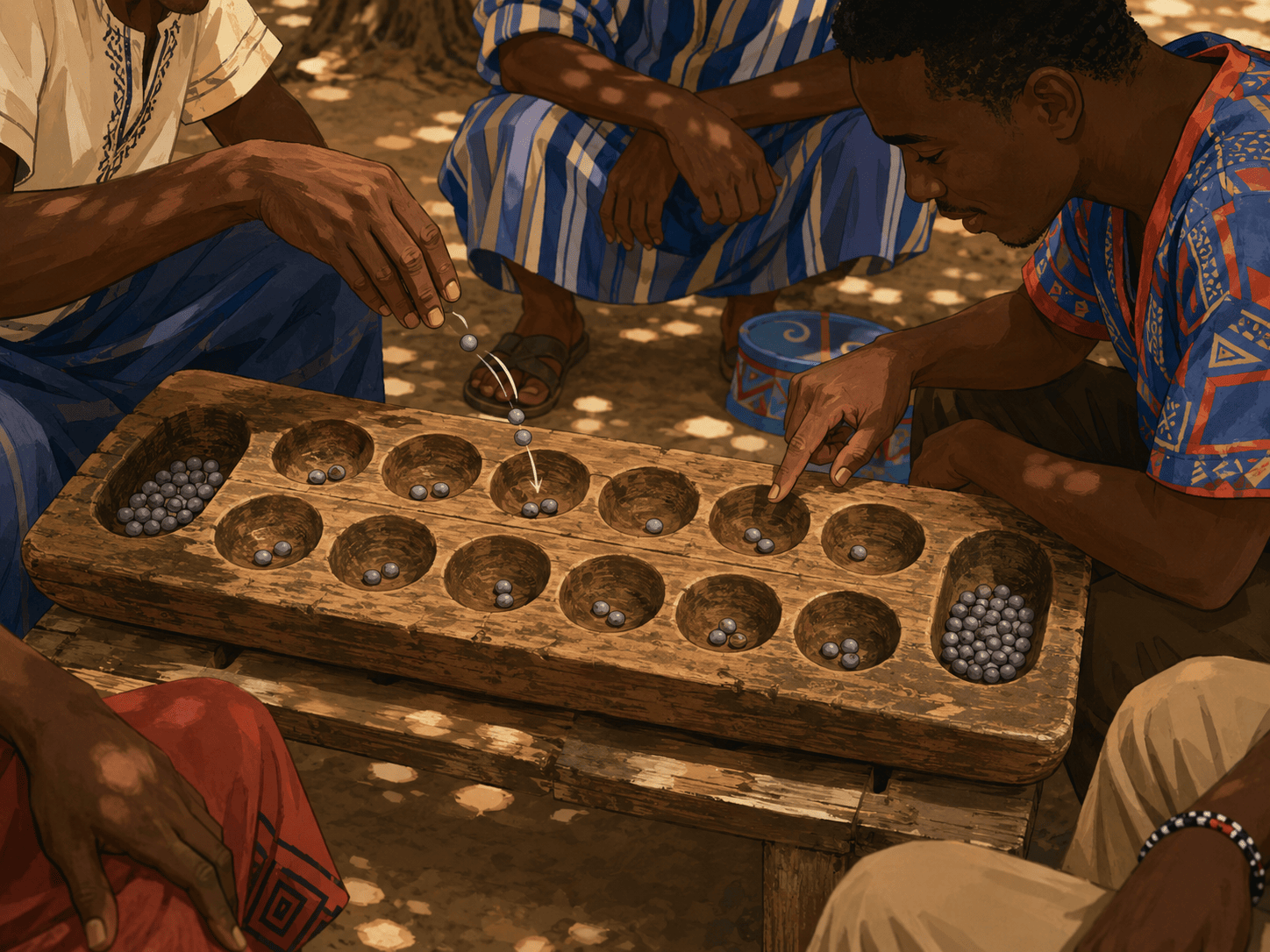
The belt's most famous voice is oware — the Ashanti name traveling farthest — played across West Africa and, via the Atlantic diaspora, the Caribbean. The shape: two rows of six pits, four seeds each, forty-eight seeds total. Sow counterclockwise; capture when your last seed lands in an enemy pit bringing it to exactly two or three; captured seeds are score. Play to twenty-five. The rules fit in a breath, and the game underneath is a sharp economy of counting, timing, and starvation strategy — genuine depth, confirmed by every serious player who visits it.
But the rules are half the story. Oware carries an etiquette with a moral center: the feeding rule. If your opponent's row is empty, you must make a move that gives them seeds if you can — you may not starve a player out of the game while holding the means to feed them. It's a rule of play and it reads as a proverb, which in the oware tradition is no accident: the game lives in social space — under shade trees, at market edges, across generations — and its boards are carved, kept, and inherited as household objects. A fine oware board with a lid and handle is furniture, heirloom, and standing invitation at once.
Bao: the deep one
Travel east to the Swahili coast — Zanzibar, coastal Tanzania and Kenya — and meet the family's famous heavyweight: bao. Four rows of eight pits, complex placement and capture phases, and the engine's wildest feature at full power: multi-lap sowing, where a capture feeds back into your hand and the sowing continues, chaining consequences around the board in sequences that can transform the whole position in one turn.
Bao's reputation is earned and specific: it is widely considered the family's deepest game, and among the most demanding traditional games anywhere. Masters — the title bingwa is carried with real prestige — calculate long sowing chains at speed, and the game's culture prizes exactly that: rapid play, deep reading, memory under pressure. Championship bao under the coast's tournament traditions is blitz-calculation as spectator sport. For this library's readers the lesson is familiar in shape: interaction multiplies depth — and bao's chained sowing is among the highest-interaction mechanisms ever evolved, a folk game outcalculating most designed ones.
Beyond Africa: the belt keeps going
Follow the Indian Ocean trade routes and the belt travels with them — games as passengers, the sowing engine crossing wherever ships and caravans went. South India and Sri Lanka play pallanguzhi, a seven-pit tradition of dazzling finger-speed. Southeast Asia sows congkak in Malaysia and Indonesia, sungka in the Philippines — long boards with big store pits at the ends, taught grandmother to grandchild. Central Asia plays toguz korgool — "nine sheep droppings," the name a whole pastoral world in miniature — with its own federations and championships. The Middle East and Caribbean hold their own branches, the latter carried across the Atlantic in the diaspora's memory.
Every stop retuned the engine — different pit counts, capture rules, laps — and kept the essentials: seeds, pits, sowing, and the game's place inside daily life rather than beside it. The belt is the best surviving demonstration that a sufficiently simple, sufficiently deep mechanism can localize endlessly without losing itself. One grammar, a hemisphere of dialects.
Counting as culture
Why did the sowing engine, of all mechanisms, achieve this spread? Part of the answer is what it trains. A sowing turn is a live arithmetic problem — count a pit, project the lap, land the last seed exactly — and expert play is running arithmetic at conversation speed. Across the belt, the game has served for generations as informal schooling: children learn counting at the board; elders stay sharp at it; and the standing dominance of the old players — a feature of mancala culture everywhere — is a public advertisement that this game is won by mind, not reflexes.
Add the world's most improvisable equipment — pits scooped in earth, seeds or pebbles or shells, a board literally makeable with two hands in one minute — and the spread explains itself. The engine is the immortality checklist with sand under its nails: child-holdable rules, adult-proof depth, equipment from the ground itself, a duel by nature, and centuries of local culture. Of every family this library covers, mancala wears the five ingredients most visibly.
Playing today: joining the belt
The tradition is fully joinable, with a little care about where you step. Start with oware — the rules above are complete enough to begin, physical sets are widely sold (or improvised with an egg carton and dried beans, in the family's true spirit), and apps offer practice against AI at every level. Expect the first evenings to be about counting fluency; the strategy arrives as the arithmetic automates. Meet kalah knowingly: the simplified western variant many apps default to is a fine gateway but a solved, shallower cousin — the family guide explains the difference; graduate to oware rules early. Approach bao late and humbly: it rewards a year the way other games reward a month.
And if travel brings you to the belt itself — a shade-tree oware session, a coastal bao bench — arrive as a guest: watch a while before asking in, expect local rules to differ from your app's, and treat the differences as the treasure they are. You're not correcting a variant; you're being handed one village's tuning of a thousand-year-old engine. Collect it. (More graceful-guest craft in the traveler's guide.)
Learn oware in one evening
The belt is joinable tonight, and here's the complete on-ramp. Equipment: an egg carton makes the twelve pits; two cups are the stores; forty-eight of anything small — beans, buttons, coins — are the seeds. Four per pit. Sit facing your opponent; your row is the one nearer you.
The turn. Scoop all seeds from any pit on your row. Sow them one per pit, counterclockwise, skipping nothing. That's it — no choices mid-sow. All your decisions happen when you pick the pit.
The capture. If your last seed lands in an enemy pit and brings it to exactly two or three seeds, you capture that pit's seeds. And it chains backward: if the pit behind it (the one you sowed just before) is also an enemy pit on two or three, take that too, and keep walking back until the chain breaks. First to twenty-five seeds wins.
The manners. Two rules keep it honest. You may not count seeds out of a pit to plan — count with your eyes, not your fingers; the arithmetic is the skill. And if your opponent's row is ever empty, you must play a move that feeds them if you have one. Starving a helpless opponent isn't a strategy in this family. It's a rudeness the rules forbid.
The first-week arc. Night one is counting practice — you'll miscount, land wrong, and capture by accident. Fine. By night three the arithmetic automates and you'll start seeing loading plays: building enemy pits toward one or two seeds, then timing the strike. By night seven you'll meet the real game — multi-pit capture chains, starvation timing, the long count. That's the door. The belt's thousand years of play are on the other side of it.
Questions people ask
How old is mancala really? Honestly contested. Claims of vast antiquity rest on rows of pits cut into ancient stone that might be boards — or might be gaming's favorite archaeological mirage. Solid evidence puts sowing games at well over a millennium, with the deeper past plausible but unproven. The family is certainly ancient; the exact birthday is a reconstruction problem.
Is there luck in mancala games? None — the whole belt is pure perfect-information strategy, which surprises newcomers who read the seeds as dice-like. Every sowing outcome is fully computable before you move; the only randomness is how far ahead each player can count. It's an open-board family from end to end.
Which variant should a strategy purist study deepest? Oware for the classic balance of clarity and depth; bao if you want the family's Everest. Both have living expert cultures and serious literature. The purist's real reward is watching one engine produce two utterly different masteries.
One line to keep? One mechanism, sown across half the planet for a thousand years and tuned by every village it reached — mancala is what a perfect game engine looks like after history finishes editing it.