Learn › Strategy games around the world › Games of the Americas
Patolli and the games of the Americas
Draw the usual map of game history and it's all Eurasia and Africa — chess rivers, mancala belts, Viking ships. Half the world is missing. The Americas built their own deep traditions of play: an Aztec race game with stakes high enough to frighten chroniclers, Maya games surviving in living communities, winter games thrown down snow tracks, and a story of suppression and survival unlike anything else on this shelf. Here is the missing hemisphere.
The other hemispheres of play
First, the correction. The Americas developed rich gaming cultures entirely independently — no contact with the chaturanga family, the sowing belt, or any Old World tradition. That independence makes them precious to anyone who cares about games. They're a second experiment: a fresh run of what humans do with boards, pieces, and chance. And the results rhyme with the Old World's to a degree that should raise your eyebrows. Race games with lot-casting. Gambling cultures around them. Games woven into ritual calendars. Boards scratched into public stone. Different hemisphere, same species, same instincts.
The record is harder to read here, for reasons the article will face honestly — conquest burned much of it — but what survives is vivid, and some of it is still being played. Take the tour.
Patolli: beans, mats, and high stakes
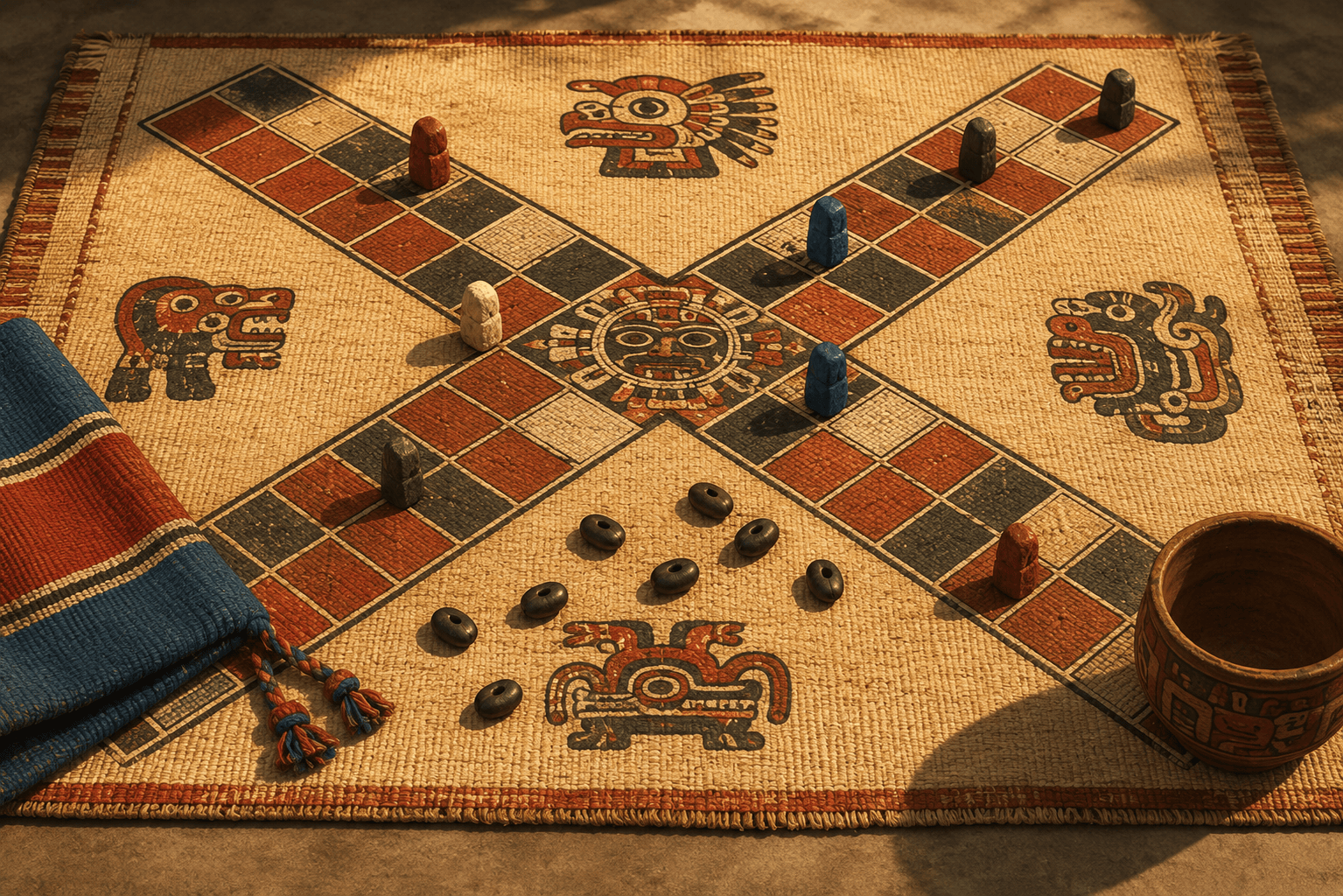
The headliner is patolli, the great race game of the Aztec world — and of much of Mesoamerica before them, with related games reaching deep into earlier centuries. The equipment: a mat painted with an X-shaped track of squares, a handful of drilled beans for dice, and colored stones as runners. Players cast the beans and raced their stones around the cross, hunting favorable squares and dodging penalties, first to bring the team home winning the stake.
And the stakes were the spectacle. Spanish chroniclers recorded patolli gambling with a mixture of fascination and horror. Players staked goods, jewels, clothing — escalating in famous accounts to homes and even personal freedom. The game ran hot through Aztec society, commoners to nobles. And it ran deep: the casting of lots carried religious weight, players invoked the gods of games and chance, and play, luck, and the sacred braided together in a way the Old World's dice would find perfectly familiar. Patolli was entertainment, casino, and minor liturgy at once. That's exactly why it drew the attention that nearly erased it — the suppression chapter below.
The Maya and beyond
Southward and earlier, the Maya world played too — and here the record shows both faces of the reconstruction problem. Archaeology finds game boards scratched into the stone of Maya sites: patolli-family crosses and grids on temple floors and benches, the classic graffiti-board phenomenon. Play happened at every level, palace to plaza. What's mostly missing is the rules, lost with so much else of the written record.
But the Maya chapter has something rare: a living thread. A war-themed race game called bul has been documented among Maya communities into the modern era — kernels counted along a track of maize, enemy runners captured. Researchers debate how directly it descends from pre-conquest play. Whether unbroken chain or later synthesis, it's one of the hemisphere's most tantalizing survivals: possibly an ancient American game that never stopped being played, just quietly, far from the museums. The honest label, as ever on this shelf: continuity plausible, proof partial. The game itself, gloriously, doesn't care. It's still fun.
North American traditions
North of Mesoamerica, the record shifts from boards toward a broader idea of the game — and the shelf should widen with it. The great tradition here is the dice-and-bowl family. The dice are two-sided lots: plum stones, bone discs, painted fruit pits. Toss them in a bowl or basket, score by the combination that lands, keep tally with counting sticks. Many nations played versions under many names — New England colonists wrote of "hubbub," after the players' chanted hub hub hub. And these were serious games: high-energy, deeply social, played at gatherings with real stakes and real audiences.
Alongside them ran games of skill tied to season and ceremony. Snow snake, the Haudenosaunee winter sport, sends a polished wooden rail skimming down an iced trough for distance — and it's still thrown today. Hoop-and-pole games tested aim across the continent. And everywhere, play was integrated into social and ceremonial life rather than fenced off from it: games marked seasons, settled contests, entertained the spirits as well as the crowd. If the Old World shelf teaches that games are culture's furniture, the North American record teaches the stronger version: sometimes they're part of the calendar itself.
Andean and Amazonian threads
South America's record is the thinnest — and the thinness is itself informative. Colonial-era chronicles describe dice-like games in the Andes, including the pichca, a five-sided die tradition, and various race and counting games. Archaeology contributes possible boards and gaming pieces. Scattered folk games with plausible pre-conquest roots survive in highland communities. But compared with Mesoamerica's painted mats, the Andean gaming record is fragments and inference — a reminder that rule loss isn't an ancient-history problem. It happened here, within recent centuries, under documented pressure.
The counterweight is the present tense: community researchers and cultural revival projects across the region work to document surviving games, republish reconstructed ones, and teach them to children — the same reclamation energy running through indigenous communities hemisphere-wide. The Americas' game history isn't a closed file. It's an active recovery.
Suppression and survival
Now the chapter that makes this shelf different from every other regional tour. The American traditions didn't fade by replacement or drift — they were suppressed. Spanish missionaries, seeing gambling and idolatry braided into patolli, banned it and burned mats and beans; chroniclers record players hiding games and playing in secret. Across the hemisphere, colonial and later assimilationist policies pushed indigenous play — like indigenous language and ceremony — toward the margins for centuries.
Two ironies keep the record alive. First: the suppressors were also the recorders. Missionary chronicles hostile to the games preserved our best descriptions of them — accidental archives, written by their enemies. Second: suppression never fully worked, because games are unconfiscatable. Rules live in heads. Equipment improvises from anything. An X can be scratched in any courtyard. So the games went quiet, went rural, went underground — and pieces of them came back out. Modern reclamation projects now teach patolli in schools, run tournaments for traditional dice games, and throw snow snakes in leagues: play as living heritage, recovered on purpose. It's the shelf's hardest story and its most hopeful — proof that even history's heaviest hand couldn't fully pry a game from a people.
Why this shelf matters
Close the world tour with what the second experiment proves. Two hemispheres, isolated for millennia, both invented: boards and runners, lots and stakes, race tracks and capture, games in graves and games on temple steps, gambling scandals and grandmothers who always win. The fair-fight instinct — sit down, agree on rules, contest something by wit and luck, demand a rematch — isn't Eurasian heritage. It's human equipment, standard issue, invented everywhere independently because it was always inside us.
That's the note the whole world-tour shelf ends on, and it lands harder from this hemisphere than anywhere. Even conquest, ban, and fire couldn't remove play from a people. They could only drive it into the one archive nothing reaches: memory, habit, and the next generation's hands. Games survive in people. The Americas proved it the hard way.
Bring the hemisphere to your table
The best way to honor a recovered tradition is to play it, so here are two games from this article, ready for tonight.
A patolli evening. Draw the X: a cross of squares, twelve or so per arm, meeting at a center. Dice: five beans or coins, one side marked — cast them and count the marked faces; five marks scores extra in most reconstructions. Runners: six small stones per player. The loop: cast, enter runners on your arm of the X, race them around the cross, land exactly to leave the board. Landing on an opponent's stone sends it home. First to bring all runners around wins the pot — and there must be a pot: play for pretzels, chores, anything. Patolli without stakes is a hymn without music; the reconstructions agree on that much. Expect it fast, loud, and mean in the best way.
A bowl-game evening. Six two-sided tokens — coins work, though painted plum stones are traditional. Toss them in a bowl with one sharp shake. Score by uniformity: all faces matching is the jackpot, five-of-a-kind scores well, mixed results score little or pass the bowl. Keep tally with ten counting sticks; first to hold them all wins. It sounds simple because the mechanism is — the game lives in the tempo, the chanting, and the crowd, which is why it filled gathering lodges. Play it with at least four people and noise.
Both games come with the same footnote: you're playing respectful reconstructions of living heritage — read a page about their peoples as the price of admission, and if a reclamation community near you teaches them, learn there. Games stay alive by being played. This hemisphere's games earned that twice over.
Questions people ask
Can I play patolli today? Yes — reconstructed rulesets (built from chronicle descriptions and surviving imagery) are published and playable, with mats printable and beans substitutable. As with Senet, treat any modern patolli as excellent scholarship rather than gospel: the experience — the cast, the race, the stakes-tension — is well-supported; the fine print is reconstruction. It plays fast and rowdy, and it's a superb family game night with a history lesson attached.
Did the Americas have pure-strategy games without luck? The clear record favors lot-casting games, but strategy-forward candidates exist — bul's capture play among them, plus various documented alignment and hunt games. Given how much was lost, absence of evidence is weak evidence of absence; the honest answer is "probably more than we can prove," the reconstruction problem in one sentence.
Is it appropriate to play these games as an outsider? Played with respect — learning the history, using the reclamation-community materials where they exist, treating living traditions as theirs rather than raw material — yes, and many revival projects explicitly welcome it: played games stay alive. The traveler's rule from the next article applies doubled here: arrive as a guest.
One line to keep? A second hemisphere ran the experiment independently and got boards, dice, stakes, and rematches — play isn't something cultures borrowed from each other; it's something humans keep rediscovering in themselves.